Published Studies
Equine Clinical Studies
Three published, independently reviewed studies covering the primary equine applications of BEMER Physical Vascular Therapy — post-exercise recovery, perioperative support, and back pain.
Study 1 — Randomised Controlled Trial
Post-Exercise Recovery
Dai F, et al. Effects of BEMER physical vascular therapy in horses under training. Research in Veterinary Science. 2022.
Design
Randomised, controlled, double-blind crossover
Population
12 warmblood horses in active training
Protocol
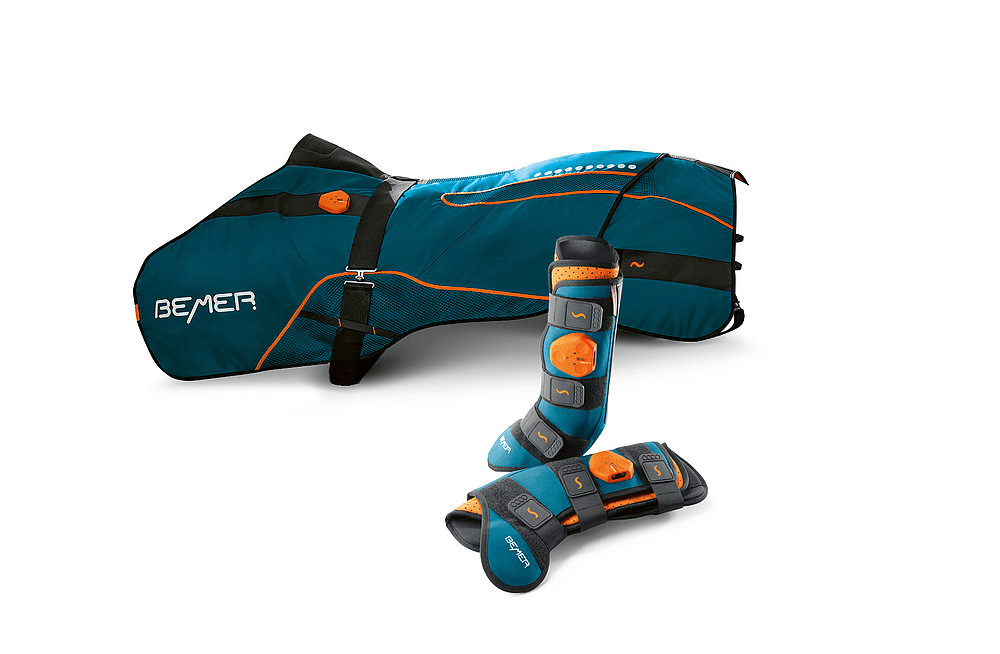
BEMER Horse-Set blanket post-moderate exercise; crossover design (each horse its own control)
Accelerated recovery of haematological and biochemical blood parameters within 1 hour
Reduced physiological stress markers (HRV, LF/HF ratios, eye temperature)
Reduced behavioural stress indicators
Faster return-to-training readiness
The crossover design eliminates individual variation — each horse serves as its own control, making this a particularly strong study design for equine research.
Study 2 — Randomised Controlled Trial
Perioperative Support
Brandenberger O, et al. Effect of BEMER Horse Therapy on Cardiopulmonary Function and Recovery Quality After Isoflurane Anaesthesia. Animals. 2024;14(24):3654.
Design
Investigator-blinded, placebo-controlled RCT
Population
100 horses undergoing pars-plana vitrectomy under general anaesthesia
Protocol
15-minute BEMER blankets positioned under and over the horse during general anaesthesia
Detectable effect on recovery quality scores
Trends toward better haemodynamics and lower lactate/CK
No adverse events in either group
The largest equine BEMER RCT — 100 horses, blinded design, investigating an entirely novel application: intraoperative microcirculatory support.
Study 3 — Cohort Study
Back Pain and Biomechanics
King MR, Frisbie DD, Seabaugh KA, et al. Effects of a Bio-Electromagnetic Energy Regulation Blanket on Thoracolumbar Epaxial Muscle Pain in Horses. Journal of Equine Veterinary Science. 2022.
Design
Cohort study
Population
8 performance horses with naturally occurring thoracolumbar back pain
Protocol
Blanket twice daily, 5–15 minutes, 3 consecutive days
Significant clinical reduction in back pain scores
Improved postural control
Improved spinal flexibility and biomechanics
Three days of twice-daily sessions produced measurable biomechanical improvement — a clinically meaningful result for the most common musculoskeletal complaint in working horses.
Evidence Summary
Supporting Observational Data
Nawrot et al. 2024: Limb perfusion thermography — increased digital artery/vein diameter and surface temperature post-BEMER
Genn, Leser et al. (clinic observation, ~1,000 cases/year): pre/post-surgical calming, deeper anaesthesia, faster recovery
All studies confirm a well-tolerated safety profile with no adverse events reported
Thermography images coming soon
Before/after thermography showing increased limb perfusion following BEMER application (Nawrot et al. 2024)
Get Well Now is an independent BEMER SA agent and does not conduct or fund research. The studies referenced here reflect published, publicly available evidence. Always discuss BEMER therapy with your veterinarian in the context of your horse's specific health and training circumstances.